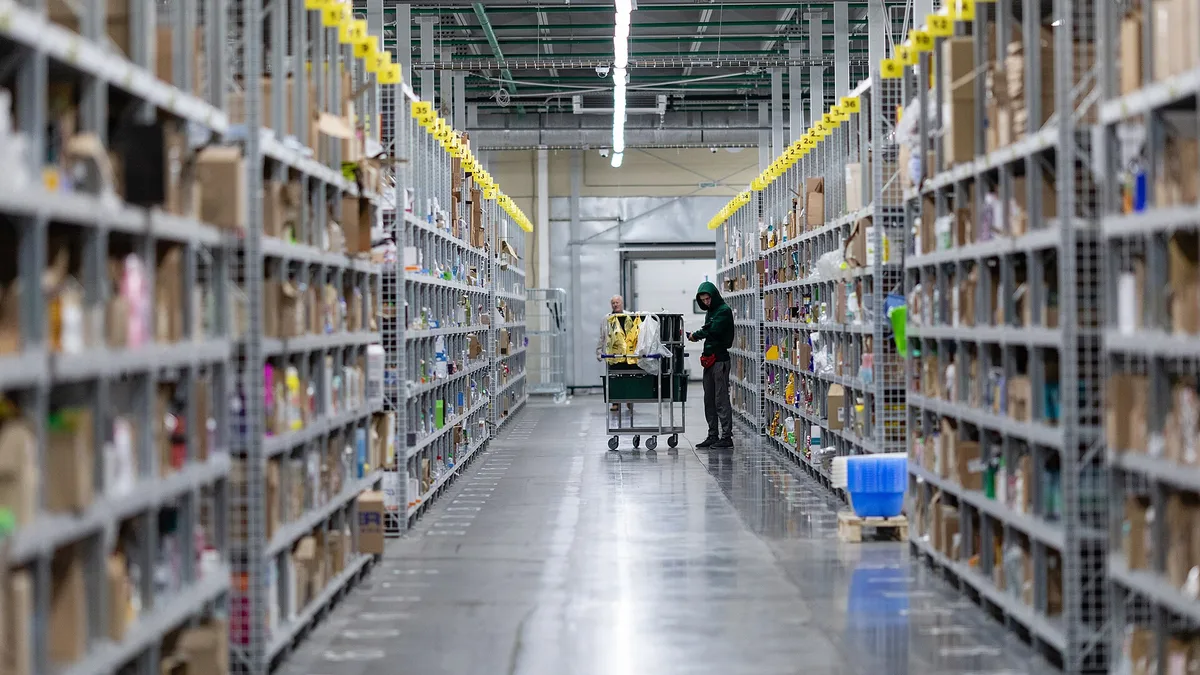
Dark Store
| Retail channel | Online-only grocery delivery |
|---|---|
| Chain competing in it | Ahold Delhaize (Peapod), Ocado, Amazon Fresh |
| First created | 2010s |
| Original use | Fulfilling online grocery orders with warehouse efficiency |
| Facility type | Automated warehouse or converted retail store |
| Order fulfillment | Picking from warehouse shelving, not public sales floor |
| Customer access | No public entry; staffed by pickers and delivery personnel |
| Location strategy | Urban or suburban, near delivery catchment area |
Origin and history
The dark store format originated in the United Kingdom and the United States in the early 2000s, emerging as a logistical response to the growth of online grocery shopping. Its development was closely tied to the early experiments and subsequent scaling of dedicated e-commerce fulfillment by major supermarket chains. The concept gained significant traction and formalization in the 2010s as pure-play online grocers and rapid delivery startups adopted the model. It represents an evolution from using the backrooms of traditional supermarkets for online order picking, which proved inefficient for high-volume operations. The model was further accelerated by shifting consumer habits and technological investments in warehouse management software. The term "dark store" itself became widely used in industry and real estate lexicon during the 2010s to describe these customer-free retail facilities.
What it is for
A dark store is a retail facility that looks like a conventional supermarket but is closed to the public and operated solely for fulfilling online orders. Its primary purpose is to serve as a dedicated fulfillment center for a retailer's e-commerce channel, optimizing the process of picking and packing groceries for customer delivery or pickup. The format is designed to eliminate the operational conflicts between in-store shoppers and pickers, which slow down efficiency in a traditional store setting. By removing customer-facing elements like elaborate displays, wide aisles, and checkout lanes, the space can be configured for dense storage and streamlined worker pathways. It functions as a critical node in a hub-and-spoke logistics network for rapid delivery services, aiming to deliver goods within an hour or less. The model also allows chains to expand their online delivery reach into new urban markets without the cost and complexity of opening full-scale, public supermarkets.
Pros and cons
A significant advantage of the dark store model is its operational efficiency, as layout and inventory can be optimized purely for picking speed, leading to faster order fulfillment and lower labor costs per order compared to store-based picking. It also reduces congestion in consumer-facing stores and can be situated in cheaper real estate locations, such as industrial parks. However, a major con is the substantial capital expenditure required to establish a network of these dedicated facilities, which duplicates a retailer's real estate footprint without generating any walk-in sales. The model suffers from high vulnerability to shifts in delivery demand density; a dark store in a poorly chosen location can become a costly white elephant with low utilization. Many rapid-delivery startups that over-invested in dense dark store networks have regretted the model when customer acquisition costs soared and order volume proved insufficient to cover the high fixed costs. A common mistake is underestimating the last-mile logistics complexity and cost, which can erase the efficiency gains made inside the dark store itself.
Who it suits
The dark store format best suits large, established grocery chains with a significant and growing online sales volume that is straining their existing store-based fulfillment capabilities. It is also a core model for venture-funded rapid delivery startups and pure-play online grocers whose entire business proposition depends on fast, reliable fulfillment without the overhead of maintaining public stores. The model suits operations in densely populated urban areas where a high concentration of orders within a short radius can justify the fixed facility cost and enable profitable last-mile delivery. Retailers with a strong private label assortment and standardized inventory benefit more, as dark stores can be stocked precisely for predicted online demand. It is less suitable for regional chains with low online penetration or for serving sprawling suburban and rural areas, where delivery distances are too great and order density too low. The format is a strategic fit for companies willing to make long-term bets on the permanent shift of grocery spending to e-commerce and that have the capital to invest in the required infrastructure.
Latest Dark Store news
Latest reporting
Ola Electric Expands Dealer Network to Tackle Supply Shortage
Ola Electric is rapidly closing its company-owned stores and building a 700-store dealer network by March 2027 to address production bottlenecks and...
GIVA secures $100 million funding for offline retail expansion
Jewellery brand GIVA raised over $100 million in a funding round led by Multiples Alternate Asset Management to accelerate its offline store network...
Blinkit Store Expansion Widens Gap with Swiggy Instamart Margins
Eternal's Blinkit grew net order value 79.3% to ₹20,940 crore with a profit, while Swiggy's Instamart grew 34.8% to ₹6,594 crore with an ₹895 crore...

EverBrands India files IPO to fund Subway store expansion
EverBrands India has filed for a Rs 600 crore IPO, planning to use over half the proceeds to open 460 new company-owned Subway stores and repay debt.
Skechers shifts to experiential retail in Southeast Asia
Skechers has grown from under 10 to over 1,000 points of sale in Southeast Asia since 2009. The brand is now pivoting from pure scale to localized...
Amazon invests $3 billion in India quick commerce by 2030
Amazon plans a $3 billion investment in India's quick commerce sector by 2030, aiming to expand its store network and market share in a rapidly...